

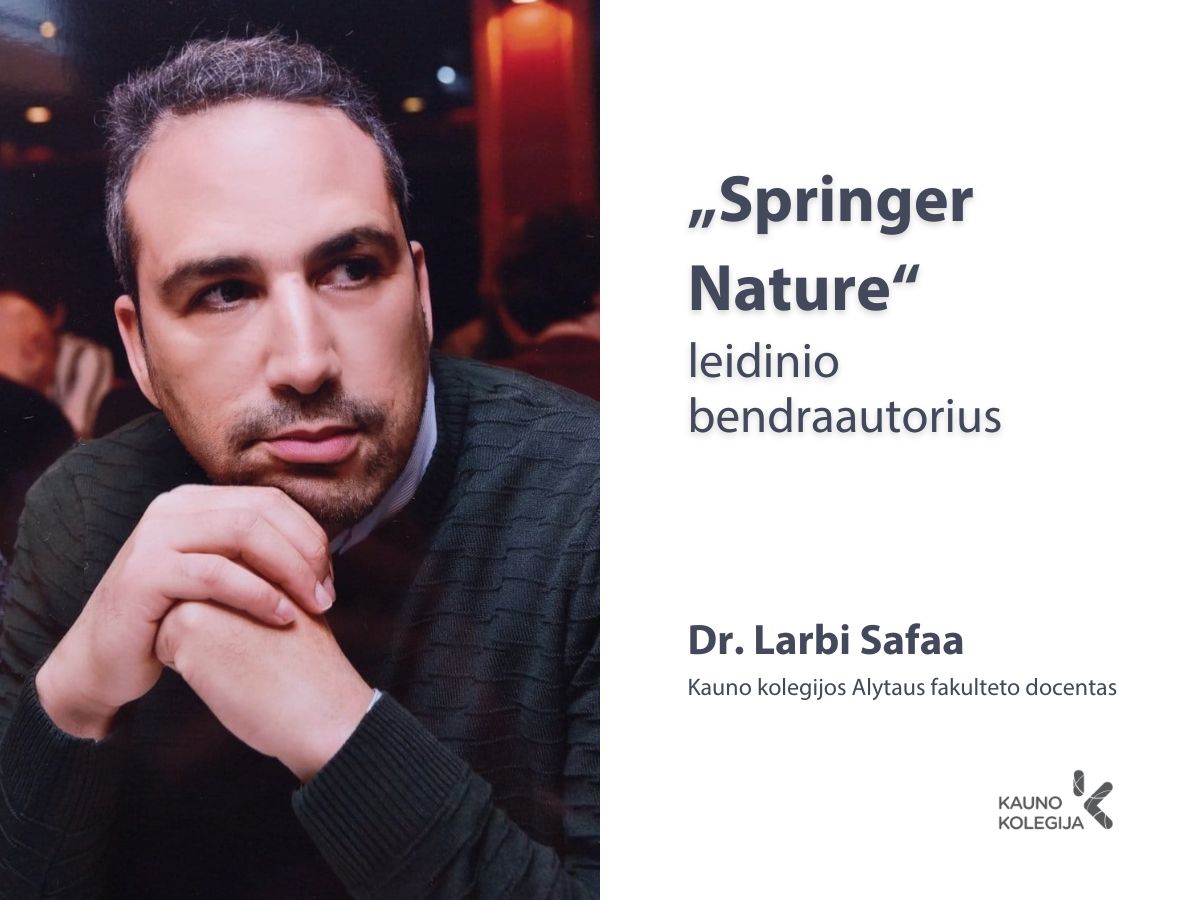
Associate Professor Dr. Larbi Safaa from Kauno kolegija, Alytus Faculty, has recently contributed to an important new publication with “Springer Nature”, further strengthening the institution’s growing presence in international research on tourism innovation and digital transformation.
The chapter, titled “A Comprehensive Overview of the Business Model Canvas for Immersive Experience Offerings: The Case of Marrakech’s Leisure and Entertainment Tourism SME Sector,” appears in the volume “Tourism Entrepreneurship and the Metaverse” and brings fresh insight into how tourism businesses can integrate immersive technologies to enhance visitor experiences.
Co-authored with an international team of researchers, the study examines how small and medium-sized enterprises in Marrakech design and implement immersive experiences using Business Model Canvas, a widely recognized strategic tool developed by Osterwalder and Pigneur. Based on qualitative interviews with representatives from three innovative SMEs (Small Medium Enterprises), the research reveals the strategic thinking behind experience design and the factors that enable companies to stand out in a highly competitive tourism environment.
The findings show that while immersive technologies offer powerful opportunities to enrich cultural tourism and strengthen visitor engagement, SMEs continue to face financial limitations and regional inequalities that slow down innovation. The study highlights how the Business Model Canvas can help businesses structure their ideas, clarify their value propositions, and develop customer-oriented offerings that reflect the cultural richness of Marrakech.
At the same time, it emphasizes the need for stronger institutional and policy support to ensure that SMEs can access the resources needed to adopt new technologies and diversify their revenue streams. Dr. Safaa’s contribution to this chapter reflects his commitment to advancing the fields of tourism innovation, experiential design, and SME development. His work enriches the academic landscape at Kauno kolegija as well as strengthens collaborative ties between Lithuania and international research communities.
For more detailed insights, the full chapter is available at the official Springer page: https://link.springer.com/chapter/10.1007/978-3-031-96299-8_7
Comments